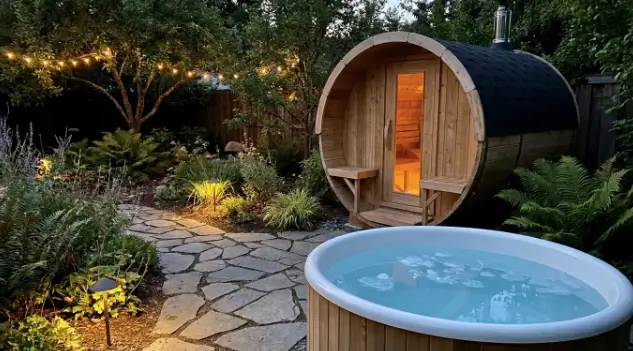
Cedar suits a sauna kit installed outdoors, fully exposed to weather, or for buyers who want the strong traditional cedar aroma, since it resists rot and insects naturally and needs less maintenance over time. Heat-treated hemlock suits an indoor kit, a covered outdoor space, or a tighter budget, since it costs 15 to 30 percent less than cedar and carries almost no scent, which some buyers actually prefer. Neither wood is the wrong choice; the decision comes down to installation location, budget, and how much aroma is wanted inside the cabin.
What Actually Separates These Two Woods?
Western red cedar is naturally resistant to rot, insects, and moisture damage without any chemical treatment, and it carries a strong, recognizable scent that many buyers associate with a traditional sauna. Heat-treated hemlock starts as a lower-cost softwood and goes through a kiln process that alters its cell structure, reducing moisture content and resin to the point where it resists warping and rot nearly as well as cedar in the right setting, while ending up with almost no natural scent. Both hold up to repeated heat cycling; the difference shows up in cost, aroma, and how each performs outdoors long-term.
Which Wood Makes More Sense for an Outdoor Kit?
Cedar has the edge for a kit sitting fully exposed to sun, rain, and freeze-thaw cycles, since its natural oils resist rot and insect damage without relying on a factory treatment holding up over years of weather. Heat-treated hemlock performs well outdoors too, particularly in a covered or partially sheltered spot, but a fully exposed hemlock kit in a wet climate benefits from more frequent resealing than a comparable cedar kit to maintain the same weather resistance over a decade of use.
Which Wood Makes More Sense Indoors?
Indoors, the weather resistance advantage cedar holds outdoors matters much less, since the kit is not exposed to rain or direct sun. This is where hemlock’s lower price and near-absence of scent become the bigger factors. Some buyers specifically want a lower-aroma cabin, either because a strong cedar smell is overwhelming in an enclosed room or because they plan to use essential oils and do not want the wood’s natural scent competing with it. An indoor kit is one of the more budget-friendly places to choose hemlock without giving up meaningful performance.
How Big Is the Price Difference in Practice?
Heat-treated hemlock typically runs 15 to 30 percent less than an equivalent cedar kit at the same size and configuration. On a four-person kit priced around $7,500 in cedar, the hemlock equivalent often lands closer to $5,500 to $6,300, a meaningful difference for a budget-conscious buyer. The gap narrows on smaller two-person kits and widens on larger six-person builds, since more square footage of panel material means the per-board-foot price difference compounds across a bigger kit.
Does Aroma Actually Matter for the Sauna Experience?
For a lot of buyers, yes, the cedar scent is part of why they wanted a sauna in the first place, and it is genuinely difficult to replicate with an added product once hemlock is installed. For others, a strong wood scent in an enclosed hot room is unwelcome, particularly for anyone sensitive to fragrance or planning to use the space for extended sessions. Neither preference is wrong, which is why this is one of the few sauna kit decisions that comes down almost entirely to personal preference rather than a clear performance winner.
Can You Combine the Two Woods in One Kit?
Some kit makers offer a mixed build, hemlock for the structural wall and ceiling panels where cost savings matter most, cedar for benches, backrests, and trim where hands and skin make direct contact and where the aroma is most noticeable. This hybrid approach captures some of cedar’s character and comfort without paying for an all-cedar shell. Buyers comparing full-cedar, full-hemlock, and hybrid kit options side by side can check the team at SweatDecks for wood species listed by component on individual kit pages, since not every retailer breaks down which parts of a hybrid kit use which wood.
How Should You Actually Decide Between the Two?
Start with installation location, since that answers the weather-resistance question before anything else matters. If the kit sits fully exposed outdoors year-round, weight the decision toward cedar or plan on more frequent resealing with hemlock. If it sits indoors, in a garage, or under a covered patio, weather resistance stops being the deciding factor and the choice comes down to budget and how much you want the wood’s natural scent inside the cabin. From there, check whether the price difference between the two options on a specific kit size is closer to the 15 percent end or the 30 percent end of the typical range, since a narrower gap makes cedar an easier call even for a budget-conscious buyer, while a wider gap makes the hybrid approach, hemlock walls with cedar benches, worth a closer look before committing to either wood exclusively.
What Does the Research Say About Sauna Use in General?
Wood species choice does not change the underlying health research, which is built around session frequency rather than materials. A 2018 review in Mayo Clinic Proceedings summarized cardiovascular associations reported among regular sauna users, and a separate systematic review in Evidence-Based Complementary and Alternative Medicine reported comparable associations tied to regular dry sauna bathing. A 2023 follow-up review in Mayo Clinic Proceedings examined Finnish sauna bathing alongside other lifestyle factors and found consistent associations with favorable cardiovascular outcomes among frequent users. These are population-level associations, not proof tied to a specific wood type, but they are one more reason to pick whichever wood, cedar or hemlock, actually gets used consistently rather than the one that only looks better in a listing photo.
Frequently Asked Questions
Is cedar or heat-treated hemlock better for a sauna kit? Cedar suits outdoor kits and buyers who want a strong traditional aroma. Heat-treated hemlock costs 15 to 30 percent less and has almost no scent.
Does heat-treated hemlock last as long as cedar in a sauna? In an indoor or covered installation, yes. Cedar still has an edge in fully exposed outdoor settings due to natural weather resistance.
Why does cedar cost more than heat-treated hemlock? Cedar needs no chemical or heat treatment to resist rot and insects, while hemlock requires a kiln process to reach similar performance.
Can you mix cedar and hemlock in the same sauna kit? Yes, some kits use hemlock for structural panels and cedar for benches and trim to balance cost against aroma and feel.
References
- Clinical Effects of Regular Dry Sauna Bathing: A Systematic Review, Evidence-Based Complementary and Alternative Medicine, 2018
- Does the Combination of Finnish Sauna Bathing and Other Lifestyle Factors Confer Additional Health Benefits? A Review of the Evidence, Mayo Clinic Proceedings, 2023
- Benefits and risks of sauna bathing, The American Journal of Medicine, 2001
By Nathan Pierce